 From northern Yokohama,
Japan
From northern Yokohama,
Japan
Japan and Saint Lorenzo Ruiz (circa 1600-1637), the first Filipino Saint.
(Posted on May 13, 2026)
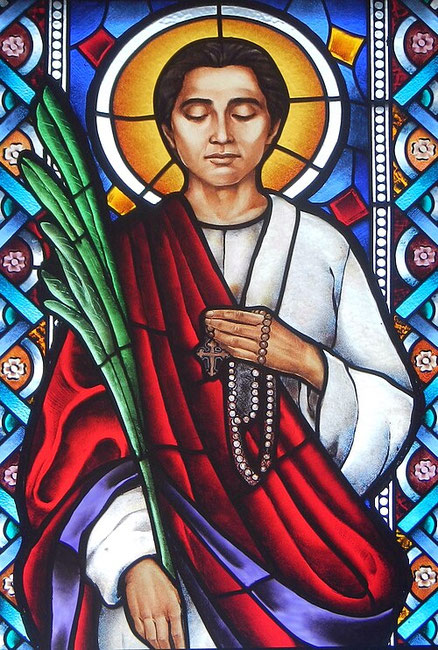
This is the stained glass of Lorenzo Ruiz, Patron Saint of Manila,
at Cubao Cathedral, Quezon City, Greater Manila.
Lorenzo was martyred in Nagasaki, Japan in 1637 during the persecution of Christians by the Tokugawa shogunate. At that time Christians were already severely persecuted in the country. It happened that whenever Christians were found, they were arrested and forced, often by torture, to renounce Christianity. Those who did not became martyrs in the end.
Do you know when Christianity was first introduced to Japan? It was relatively late in the middle of the 16th Century by a Jesuit priest named Francisco de Xavier. In 1549, Xavier sailed from Goa, a Portuguese outpost in western India, and reached Kagoshima, on the southern island of Kyushu. At first some local rulers permitted Christian priests to preach perhaps in return for seeking lucrative trade, including matchlocks with Portuguese and Spanish merchants.
Some rulers even became Christians themselves. Under their protection, churches - and in some cases, hospitals - were set up in various parts in the country. As a result, the number of Christian followers increased.
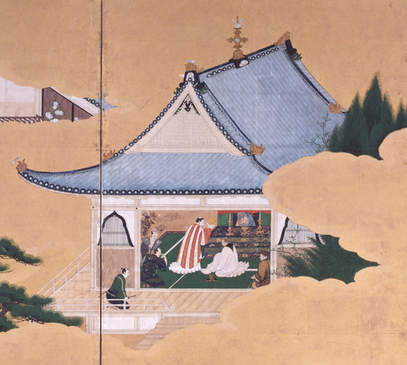
Then one asks why Christians were persecuted later on? It is said that national leaders in Japan eventually became uneasy with Christianity as compared with traditional culture based on Buddhism and Shintoism. So, their decision was to ban Christianity altogether.
Going back to Lorenzo, he was a Christian but not a priest. Lorenzo was an ordinary Pilipino raising his family in Manila, which was under Spanish rule at that time. Then something happened and he was involved in a criminal manhunt making his escape to a ship bound for Japan. In this way, Lorenzo had no choice but sailed to Japan accompanying Christian priests and nuns from various countries. Why did they go to Japan at that time knowing the country’s severe persecution?
The number of Christians in Japan had drastically dwindled by then, but some managed to retain their faith. On the surface they turned up as Buddhists but they practiced Christianity discretely. So, the Christian community outside Japan, were determined to risk sending their priests to guide those followers.
In this respect, Manila had become one of the destinations for the fleeing Japanese Christians. In 1614, a group of Japanese Christians led by an ex-warlord Justo Ukon Takayama were expelled to Manila by the Tokugawa shogunate.
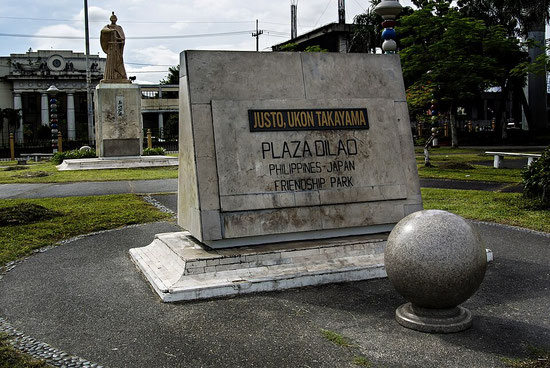
The statue and plaque of Justo Ukon Takayama in Manila
(The photo by IJVelas)
Back to Lorenzo: he reached Japan but was arrested together with accompanying members. They were sent to Nagasaki where they met their final destiny. From 1633 to 1637, altogether sixteen priests, monks and followers were martyred, consisting of nine Japanese, four Spanish, one French, and one Italian plus Lorenzo. Today, Nagasaki’s Nakamachi Church displays a memorial of all those sixteen including statues. Incidentally, Nakamachi Church was first built in 1896 but was rebuilt after it was burned down by the 1945 atomic bomb.
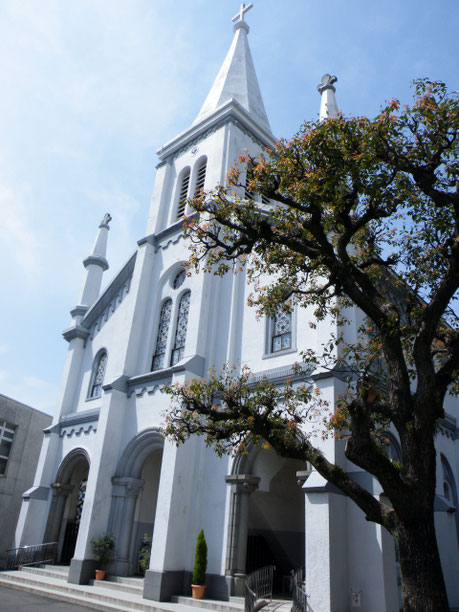
(The photo by Atsasebo)
History tells us that the Christian persecution continued even after the opening of Japan to the world in 1854. Religious freedom was proclaimed in 1858, but it was applicable for foreigners only. For the Japanese, they had to wait until 1873.
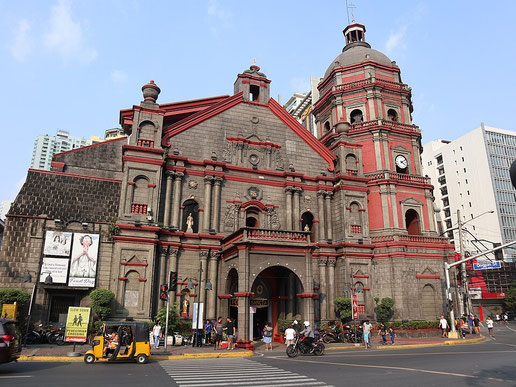
Binondo Church in Manila is dedicated to Saint Lorenzo Ruiz
(The photo by Patrickrouque01)
Facts about Yokohama
Kohoku New Town
Jike countryside

A talk with Steve
Selected photos
The Philippines
The Middle East
Selected photos of Yokohama at night
Majestic sailing vessels

Japanese Language Proficiency Test (JLPT)

For more information,
go to .....
The Information Technology Engineers Examination (ITEE)

What is it? For more information, go to ....