 From northern Yokohama,
Japan
From northern Yokohama,
Japan
Japanese oil entrepreneurs and the Middle East
(Posted on June 10, 2026)
As is well known Japan imports most of its oil from the Middle East, around 95% in 2024. Here, I would like to talk about Yamashita Taro (1889-1967), the founder of Arabian Oil Co. and Idemitsu Sazo (1885-1981), the founder of the oil company, Idemitsu Kosan. Both of them played pivotal roles in Japan’s effort to obtain oil from the Middle East.
After graduating from Hokkaido Imperial University (Agriculture Faculty) in 1909, Yamashita Taro started various businesses including ones trading cereals, steel among others. Yamashita managed to expand his operations to Manchuria, Korea, and Taiwan. However, he lost all his overseas assets when World War II ended in 1945.
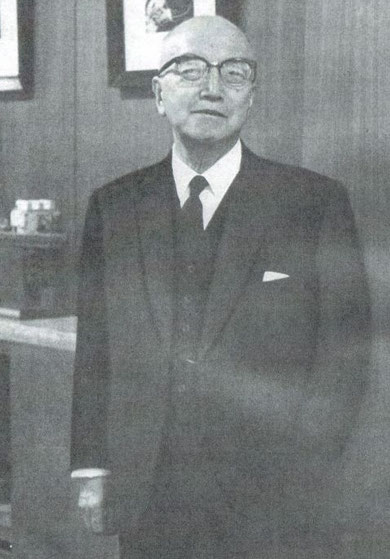
After the war, Yamashita endeavored to deal in oil, which was essential for the reconstruction of Japan. He was adamant that Japan should find oil sources from other than a dominating supplier, which was the US at that time. In 1956, he embarked on a grand project to explore oil production outside Japan after maneuvering within government and business circles. It was a great surprise to everybody when Yamashita managed to get development rights from both Saudi Arabia (1957) and Kuwait (1958) for the area designated as a neutral zone between the countries. This prompted the establishment of Arabian Oil Company (AOC) in 1958.
Two years on the company succeeded in discovering a large-scale oil field under the sea. This was named the Khafji oil field, located about 40 km off-shore. The first shipment to Japan was carried out in 1961. Lucrative production ensured further oil field discoveries: such as the Hout Oil field in the vicinity of the Khafji in 1963; and two more undersea oil fields that did not go into commercial operation. The maximum output at Khafji was 400,000 barrels per day recorded in 1979.
The khafji undersea oil field is connected by a pipeline to on-shore tank yards and then to shipping berths. The quality of the Khafji oil is heavy in sulfur content. The photos of oil production facilities can be found at foc.co.jp/ja/aoc/photo.html. A few remarks about the AOC’s further expansion activities. It’s had operations outside the Middle East: for example, production in Norway (the Gyda Oil field) in 1990, off shore production in the South China Sea in 1993 and so on.
Then as the termination of drilling rights both in Saudi Arabia and Kuwait were coming close, AOC negotiated for their extension. However, the negotiation failed and the operation in Saudi Arabia finally terminated in 2000. Thereafter, the operation was carried out jointly with Aramco Gulf Operations until 2003. For Kuwait the drilling right expired in 2003, but technical assistance by AOC continued until 2008.
As seen, AOC was the harbinger of the Japanese oil production outside Japan. Now Japan’s oil production is being carried out in many places in the world. Among them, I would like to refer to oil production in Abu Dhabi by a Japanese Company named Abu Dhabi Oil Company. In 1967 the company managed to get a production right for off-shore operations. The company succeeded to produce commercially in 1973 and the first shipment to Japan was carried out in the same year. Thereafter exploration and subsequent production have been expanded to nearby off-shore oil fields. Today more than 20 % of all oil imports to Japan comes from these Abu Dhabi oil fields.
Now turning to Idemitsu Sazo. He hailed from a family in Kyushu dealing with the wholesale of dye material. Two years after graduating from a commerce college in Kobe (today’s Kobe University) in 1909, Idemitsu managed to set up his own company handling oil products. Subsequently, his business expanded to Manchuria, Korea and other Asian countries. Like Yamashita Taro, Idemitsu lost all his assets in those countries when World War II ended in 1945. Undeterred, Idemitsu started to import oil.
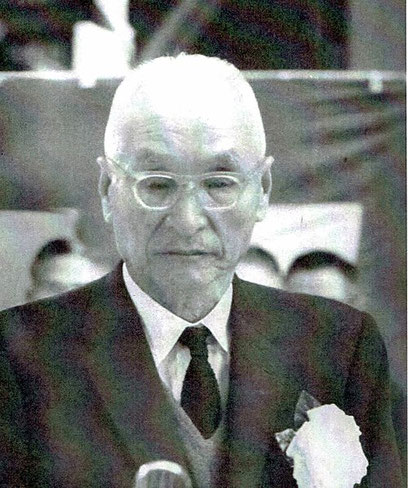
At that time, American and British oil companies were trying to dominate the Japanese markets directly or indirectly through Japanese oil companies in partnership. Idemitsu was adamant to seek his own way without the help of foreign companies, even defying government directives. There was an incident that showed Idemitsu’s guts and courage.
Regarding Iranian oil, it was controlled by a British oil company. But the Iranian government under Muhammad Mossadegh nationalized the company in 1951, creating tension between the two countries. In fact, the British Navy enacted a blockade so that no Iranian oil would be exported. To this Idemitsu sent his oil tanker, Nissho-Maru (18,000 tons) to Abadan in Iran and managed to carry gasoline and light oil back to Japan, evading the blockade. When Nissho-Maru entered the Iranian port, it was welcomed by fanfare and more. According to Idemitsu his action was not in defiance of international law.
In 1957, Idemitu Kosan started operating its own oil refinery in Japan. The company also set up petro chemical plants in 1963. Incidentally, Arabian Oil Company was officially terminated in 2025 being absorbed by Fuji Oil Company. The latter was also absorbed by Idemitsu Kosan in the same year. One more thing, Nissho-Maru the fifth (300,000 tons), carrying Saudi oil managed to pass through the Hormuz Strait in April, 2026, evading another blockade.
Today, Idemitsu Kosan is the number two oil company in Japan. A few words about the company’s past oil and gas joint production in Japan; off-shore production at Agaoki gas field in Niigata prefecture from 1976 to 1998 and at Agaoki-north from 1984 to 1993. Can you believe that Japan is the world’s 47th oil producer with an output of about 102,000 barrels per day? The small-scale production is still carried out mostly in Niigata and Akita prefectures facing the Sea of Japan, accounting for, well, less than one percent of the country’s daily consumption.
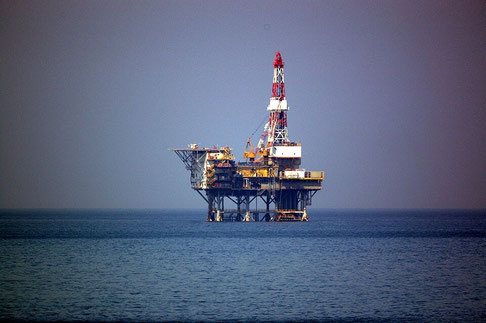
Iwafune-oki oil platform located 4 km off-shore in Niigata prefecture
(The photo by Tsuda)
A book about the life of Idemitsu Sazo was first published in 2012 entitled
“A pirate as he was called” (author’s translation).
Facts about Yokohama

Kohoku New Town
Jike countryside
A talk with Steve

Selected photos
The Philippines
The Middle East
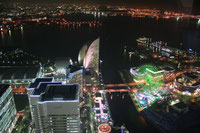
Selected photos of Yokohama at night
Majestic sailing vessels

Japanese Language Proficiency Test (JLPT)
For more information,
go to .....
The Information Technology Engineers Examination (ITEE)

What is it? For more information, go to ....